
Data Correction
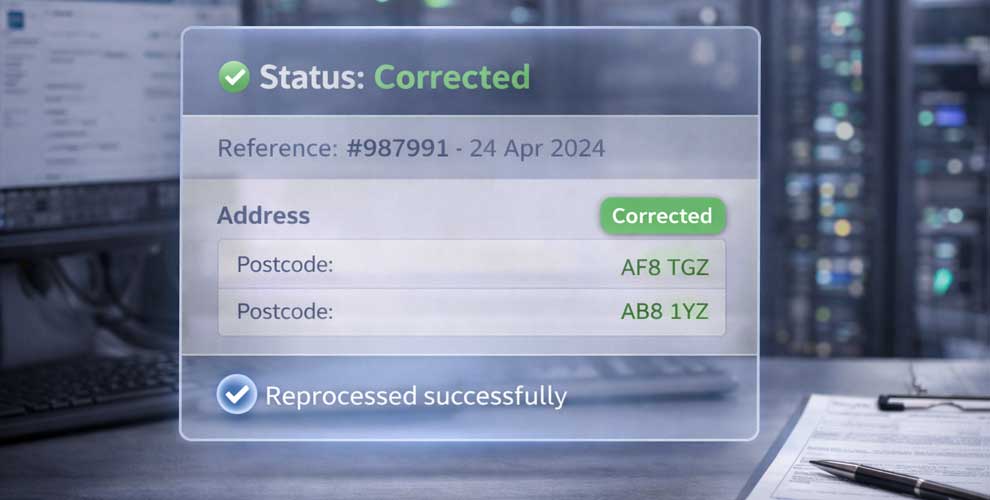
Correct issues quickly — and keep orders, despatch and invoicing moving.
Even with great integrations, real-world data isn’t perfect. A missing reference, an invalid postcode, a wrong unit of measure, or a partner-specific requirement can cause rejects and delays.
Data Correction gives your team a controlled way to fix issues and reprocess documents, without losing traceability.
The problem it solves
When corrections are unmanaged, teams resort to risky workarounds:
-
editing spreadsheets and resending manually
-
patching data in downstream systems with no audit trail
-
“quick fixes” that break later reconciliation
-
repeated rejects because the underlying issue isn’t resolved properly
-
delays while teams figure out who should fix what
Data Correction brings speed and control to exception resolution.
What Data Correction does
Fix common issues without rebuilding the flow
Correct problems such as:
-
missing or invalid fields
-
incorrect identifiers or references
-
formatting issues (dates, decimals, codes)
-
partner-specific required values
-
mapping-driven errors where a source field is incomplete
Keep corrections traceable
Corrections remain linked to the original document and its event trail, supporting governance and audit requirements.
Reduce repeated failures
By resolving issues properly and consistently, you reduce ongoing noise and repeat exceptions.
Improve operational ownership
Data Correction makes it clearer whether an issue belongs to ops, finance, support or IT — and helps teams act without bottlenecks.
How it works
1) An exception is raised
A document fails validation or is rejected by a partner.
2) Review the problem with context
See the failure reason, affected fields, and document references.
3) Apply a controlled correction
Update the relevant values and confirm the change.
4) Reprocess and track
Send the corrected document through the flow again, with full traceability of what changed.
5) Learn and improve
Spot recurring correction patterns and improve upstream data quality over time.
Key benefits
-
Faster resolution: fix issues quickly without manual rework
-
Lower reject rates: prevent repeat validation failures
-
Stronger governance: corrections stay linked to the audit trail
-
Better team workflows: reduce dependency on one technical person
-
More reliable operations: fewer delays across order-to-cash
Best-fit use cases
-
Retail suppliers dealing with strict validation rules
-
High-volume order processing where failures must be fixed fast
-
Invoice flows where rejects delay payment
-
Multi-partner environments with different requirements per customer
-
Teams wanting traceable corrections instead of “off-system fixes”
FAQ
Is Data Correction the same as Data Error Handling?
They work together. Data Error Handling detects and surfaces issues; Data Correction focuses on resolving them in a controlled way so documents can be reprocessed.
Will corrections affect audit trails?
Corrections are traceable and remain linked to the original document trail, including what changed and when.
Can we reprocess documents after correcting them?
Yes — corrected documents can be reprocessed through the same flow without losing visibility.
Does this replace fixing the source system?
Not entirely. Data Correction helps you keep operations moving while upstream fixes are made, and it highlights recurring issues so root causes can be addressed.


Need any further assitance?
Feel free to reach out for any inquiries or assistance.
Book an appointment nowRELATED NEWS
More articles to explore
Selected updates relevant to this topic—focused on deployments, partnerships, and platform progress.
- Recent deployments & roll-outs
- Regional partner updates
- Platform updates & announcements